retaining wall repair Vancouver
Retaining Wall Repair in Vancouver
Hold the slope. Protect the property.
About Retaining Wall Repair in Vancouver
Metro Vancouver's hillside terrain means retaining walls are everywhere, and they fail in predictable ways. A wall that was built without adequate drainage behind it accumulates hydrostatic pressure every wet season. That pressure pushes the wall outward, and over years it leans, cracks, and eventually fails. Timber walls rot. Block walls shift at the mortar joints. Poured concrete walls crack and blow out at the base. The right repair starts with fixing the drainage. A new wall built in the same location without solving the water behind it will fail the same way, just on a fresh timeline. We repair and stabilize retaining walls using tie-back anchors, helical piers, drainage correction, and rebuilt masonry, with engineering sign-off for any wall over one metre in height.
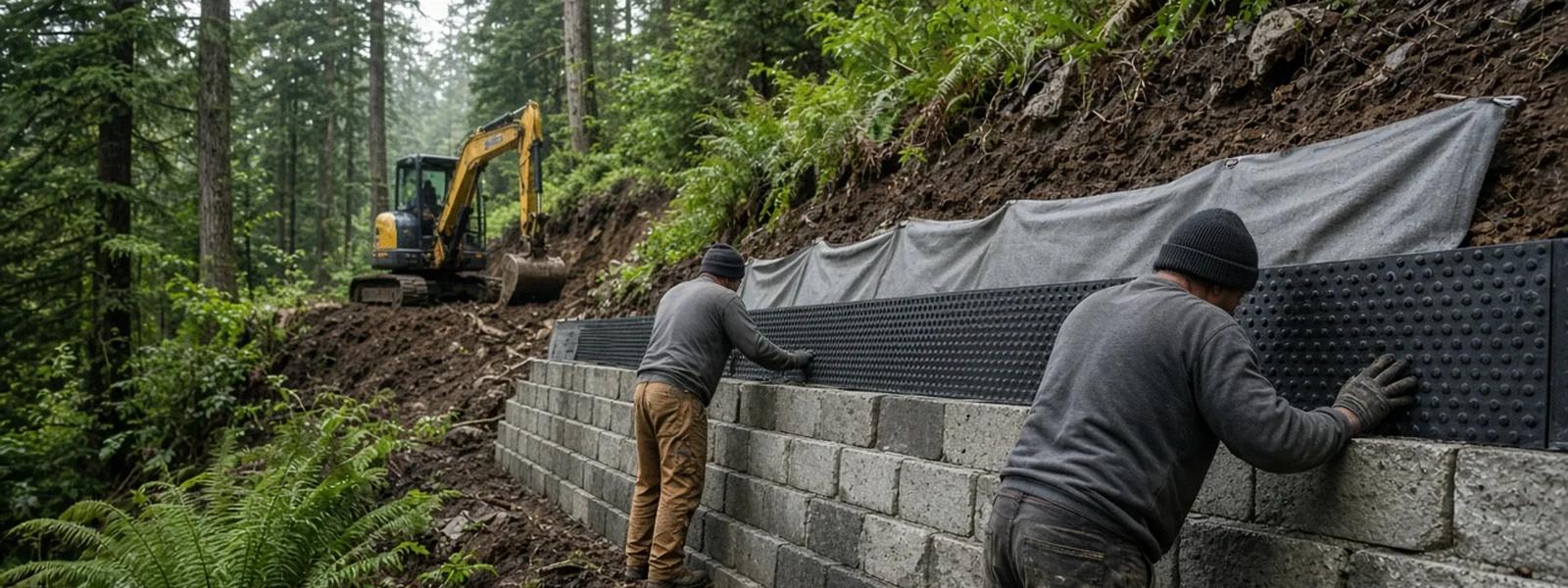
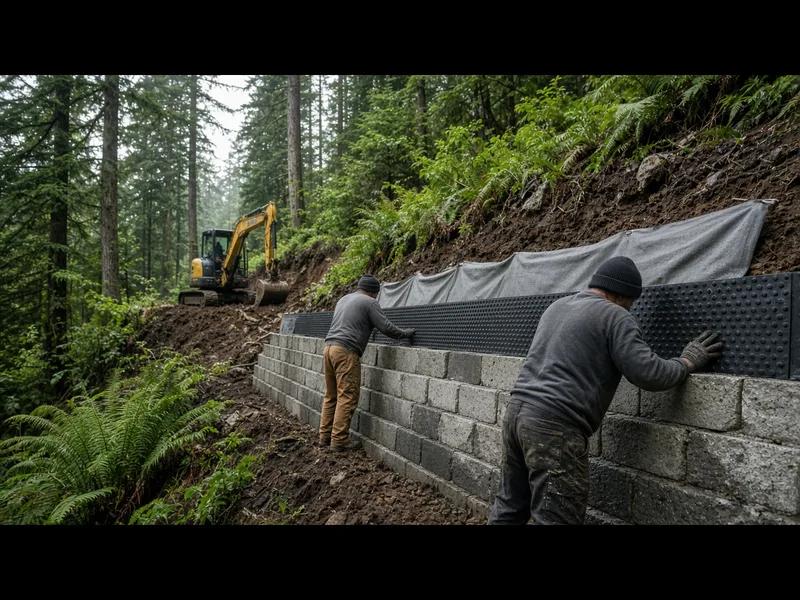
Hydrostatic pressure behind a retaining wall increases with the square of the water height: a wall retaining 1.5 m of saturated soil faces approximately four times the lateral pressure of a wall retaining 0.75 m. This is why drainage failure is catastrophic rather than gradual. The original weeping tile behind most Metro Vancouver retaining walls was installed in the 1960s to 1980s and has either silted in, been displaced by root intrusion, or was undersized for the site. Installing new drainage board and filter fabric behind the wall reduces the active pressure on the wall by 60 to 80 percent even before any structural strengthening. For walls where the lean has progressed past 25 mm at mid-height, tie-back anchors are added to hold the wall while the drainage correction is made. We always address drainage first; structural anchors alone on a wall with active hydrostatic pressure are fighting a losing battle. Elite Vancouver Foundation Repair brings the right equipment and the right method to every job.
Signs You Need This Service
- Wall leaning visibly toward the downhill side
- Cracking or displacement at block mortar joints
- Bulging at the base of the wall
- Soil washing out from behind the wall at the base
- Drainage problems above the wall that have worsened over time
Why Fix It Now
Our Retaining Wall Repair Process
Wall Assessment & Drainage Survey
We measure wall lean, probe mortar joints and timber condition, and investigate the drainage situation behind the wall. Ground-penetrating radar or exploratory pits are used where the fill condition is unknown.
Engineering for Structural Walls
Walls over one metre in height, or walls retaining soil near a structure, require a PE-stamped design. We engage a geotechnical or structural engineer as appropriate for the site conditions.
Drainage Correction
Drainage board, filter fabric, and new weeping tile are installed behind the wall to relieve hydrostatic pressure. This is the step that makes the difference between a repair that lasts and one that fails again.
Structural Repair or Rebuild
Depending on condition: helical tie-back anchors are installed to pull a leaning wall back and hold it; block walls are repointed or rebuilt; poured concrete walls are crack-injected or section-replaced; failed timber walls are removed and replaced with concrete block or poured concrete.
Ready to fix it for good?
Call now, free assessment604-373-3161Retaining Wall Repair in Metro Vancouver
North Shore and Burnaby hillside properties
Metro Vancouver's topography creates a high density of retaining walls in North Vancouver, West Vancouver, Burnaby Heights, and parts of East Vancouver where properties step up steeply from the street. Many of these walls were built in the 1950s to 1970s without drainage, with minimal engineering, and in some cases with materials that have long since reached the end of their service life. The combination of heavy rainfall, steep slopes, and saturated soil makes retaining wall failure one of the most common emergency calls we receive in January and February after a prolonged wet period.
Drainage tile lifespan and the BC wet season
The drainage tile behind most Metro Vancouver retaining walls was installed at the same time as the wall and has the same age as the wall. 60-year-old drain tile is typically either completely silted over or has been displaced by tree roots. The BC winter rainfall pattern — sustained heavy rain events rather than snow-melt spikes — means the drainage system behind a retaining wall is under its maximum stress load for three to five months every year. A silted drain tile on a December wall is equivalent to no drain tile at all.
What Affects the Cost of Retaining Wall Repair
Every job is different. These are the main variables that move the number up or down — knowing them helps you understand any quote you receive.
Wall height and length
Cost scales with both. A 2 m high wall retaining 10 m of hillside is a much larger scope than a 1 m garden wall. Structural demands increase with the square of wall height.
Repair vs. full demolition and rebuild
Tie-back anchors and drainage correction on a structurally intact wall is less costly than demolishing and rebuilding. The rebuild option is required when wall condition is too deteriorated for in-place repair.
Soil behind the wall
Walls retaining saturated clay under high hydrostatic pressure require more robust drainage systems and anchoring than walls in well-drained granular fill.
Engineering requirements
Walls retaining adjacent buildings or over 1.5 m tall require geotechnical and structural engineering. These fees are fixed costs that do not scale much with wall size.
Retaining Wall Repair FAQ
My retaining wall is leaning but has not fallen. Can it be repaired without demolishing it?
My timber retaining wall is rotting. Should I replace it with the same material?
Does a retaining wall repair need a permit?
How do I know if my retaining wall is a safety risk right now?
My retaining wall failed and took part of my garden with it. Who is responsible?
Can a failed retaining wall damage my foundation?
Free on-site assessment
Get a Free Retaining Wall Repair Assessment
Elite Vancouver Foundation Repair sends a licensed technician to take a look. No obligation, no sales pitch, and you get a plain-English report.