pre-construction piles Vancouver
Pre-Construction Piles in Vancouver
Build on ground that holds
About Pre-Construction Piles in Vancouver
Metro Vancouver's Lower Mainland sits on a mix of soft delta silt, peat, loose sand, and expansive clay. Building directly on this soil without deep foundation support leads to differential settlement, structural cracking, and expensive remedial work later. Pre-construction pile installation eliminates that risk. By installing helical or driven piles to load-bearing strata before the foundation is poured, we give the new structure a foundation that will not move. This is particularly important for new residential construction on infill lots in Richmond and Delta, secondary suites and garden suites above soft soils, additions to existing homes on clay or fill, and any light commercial construction where post-construction settlement is unacceptable.
The torque-to-capacity relationship for helical piles is an empirical correlation established by ASTM D1143 load tests: installation torque in ft-lbs multiplied by a torque factor (typically 9 to 10 for standard helix-to-shaft diameter ratios) gives the ultimate axial capacity in kips. This means capacity is verified in real time during installation with no waiting period and no load test required for most residential loads. The installation log — depth, torque at each foot of advance, and final torque — becomes a permanent record of the pile's capacity that the engineer can review. For Richmond and Delta sites where the bearing layer is at 12 to 18 m depth, helical piles are typically installed in sections of 1.5 to 3 m, coupled with bolted field couplings as they advance. The coupling locations are staggered across the pile group so they do not all fall at the same depth, which would create a plane of weakness in the array. Elite Vancouver Foundation Repair brings the right equipment and the right method to every job.
Signs You Need This Service
- New construction on a lot with known soft or fill soils
- Geotechnical report recommending deep foundation support
- New addition or garden suite above an area of previous settlement
- Light commercial construction on delta or alluvial soils
- Existing structure on adjacent lot showing settlement damage
Why Fix It Now
Our Pre-Construction Piles Process
Geotechnical Review
We review available soil data for the site. Where a geotechnical report does not exist, we recommend one before pile design begins. The pile design must match the actual soil conditions on that specific lot.
Pile Layout & Engineering
A structural engineer designs the pile cap layout, pile spacing, and minimum installation torque based on the building loads and soil data. PE-stamped drawings are submitted as part of the building permit package.
Installation
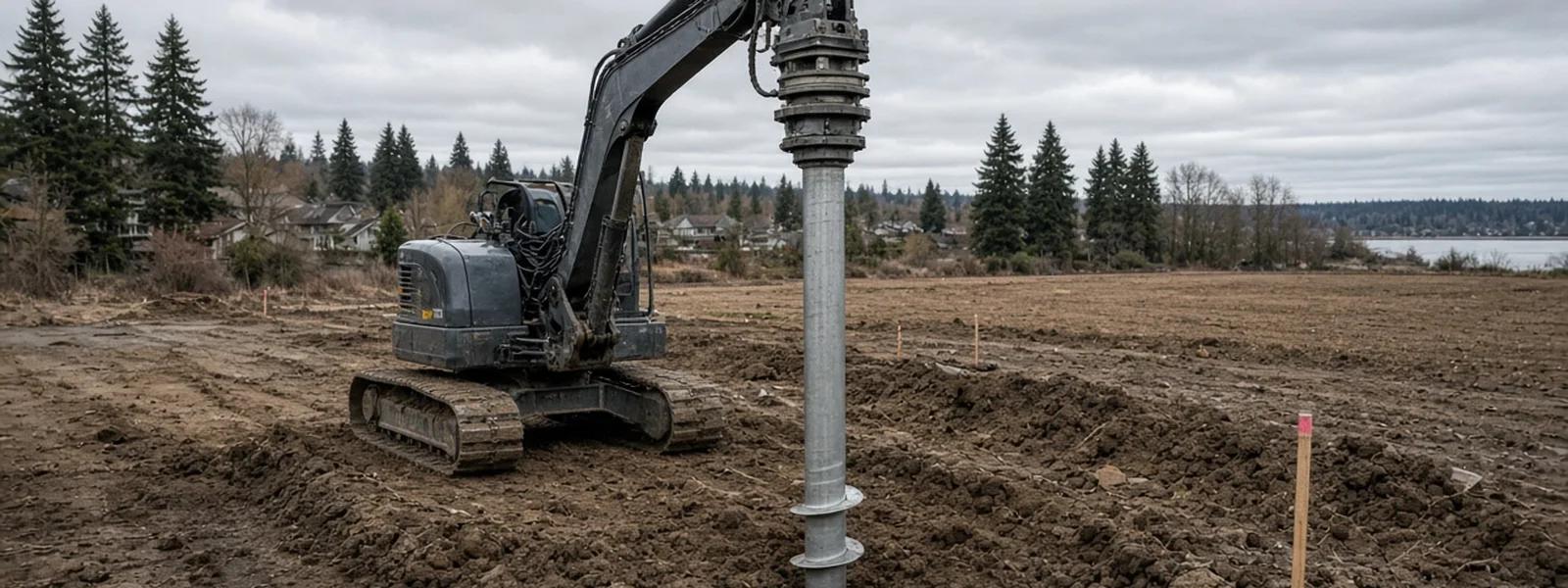
Helical piles are installed using a hydraulic torque head on a mini-excavator or skid steer. Each pile is torqued continuously and the installation log is documented in real time. Piles are installed to the minimum torque or depth specified by the engineer, whichever governs.
Cap & Handoff
Pile caps are formed and poured, or structural brackets are set, as required by the engineer's design. We provide the GC with as-built installation logs including depth, final torque, and location for every pile.
Ready to fix it for good?
Call now, free assessment604-373-3161Pre-Construction Piles in Metro Vancouver
Richmond, Delta, and the Fraser River delta problem
Richmond and Delta are built almost entirely on Fraser River delta sediments — soft organic silt, peat, and loose sand at the surface, transitioning to dense sand and gravel at 10 to 18 m depth. The upper soils have almost no bearing capacity. The City of Richmond's building bylaw requires geotechnical engineer sign-off on all new foundations, and in practice that means piles for virtually every new structure. The good news is that helical pile installation is extremely well-understood in this soil profile; the depth and torque requirements are consistent from lot to lot and the installation goes quickly.
Vancouver infill lots and secondary suites
Metro Vancouver's densification program — multiplexes, laneway houses, garden suites, and secondary suites — is creating a large volume of new foundation work on urban infill lots. Many of these lots have fill soils from previous demolition, disturbed soil from tree removal, or simply clay that has never been assessed. A $1,500 geotechnical investigation before design can determine whether you need piles; a failure to investigate and then remediate settlement after the fact costs ten to twenty times that amount.
What Affects the Cost of Pre-Construction Piles
Every job is different. These are the main variables that move the number up or down — knowing them helps you understand any quote you receive.
Pile count
Residential piling costs roughly $400 to $900 per pile installed, depending on depth and site conditions. A 15-pile residential job is therefore a meaningfully different cost from a 40-pile commercial job.
Pile depth
Richmond and Delta piles at 15 m cost more than Burnaby piles at 5 m because they need more sections, more time, and more coupling hardware per pile.
Geotechnical assessment
A site-specific geotechnical report is a prerequisite for pile design and runs $1,500 to $4,000 depending on the number of boreholes. It is non-optional for permitted work.
Engineer fees
Structural engineer design and stamp fees are fixed costs. They are proportionally higher on small jobs (5 piles) than large ones (50 piles) but do not scale linearly with pile count.
Pre-Construction Piles FAQ
My lot is in Richmond. Do I definitely need piles?
What is the difference between helical piles and driven piles?
Can piles be installed in a tight urban lot?
My building permit is already applied for. Can I still add piles?
Do garden suites and secondary suites need piles?
How long does pre-construction pile installation take?
Free on-site assessment
Get a Free Pre-Construction Piles Assessment
Elite Vancouver Foundation Repair sends a licensed technician to take a look. No obligation, no sales pitch, and you get a plain-English report.