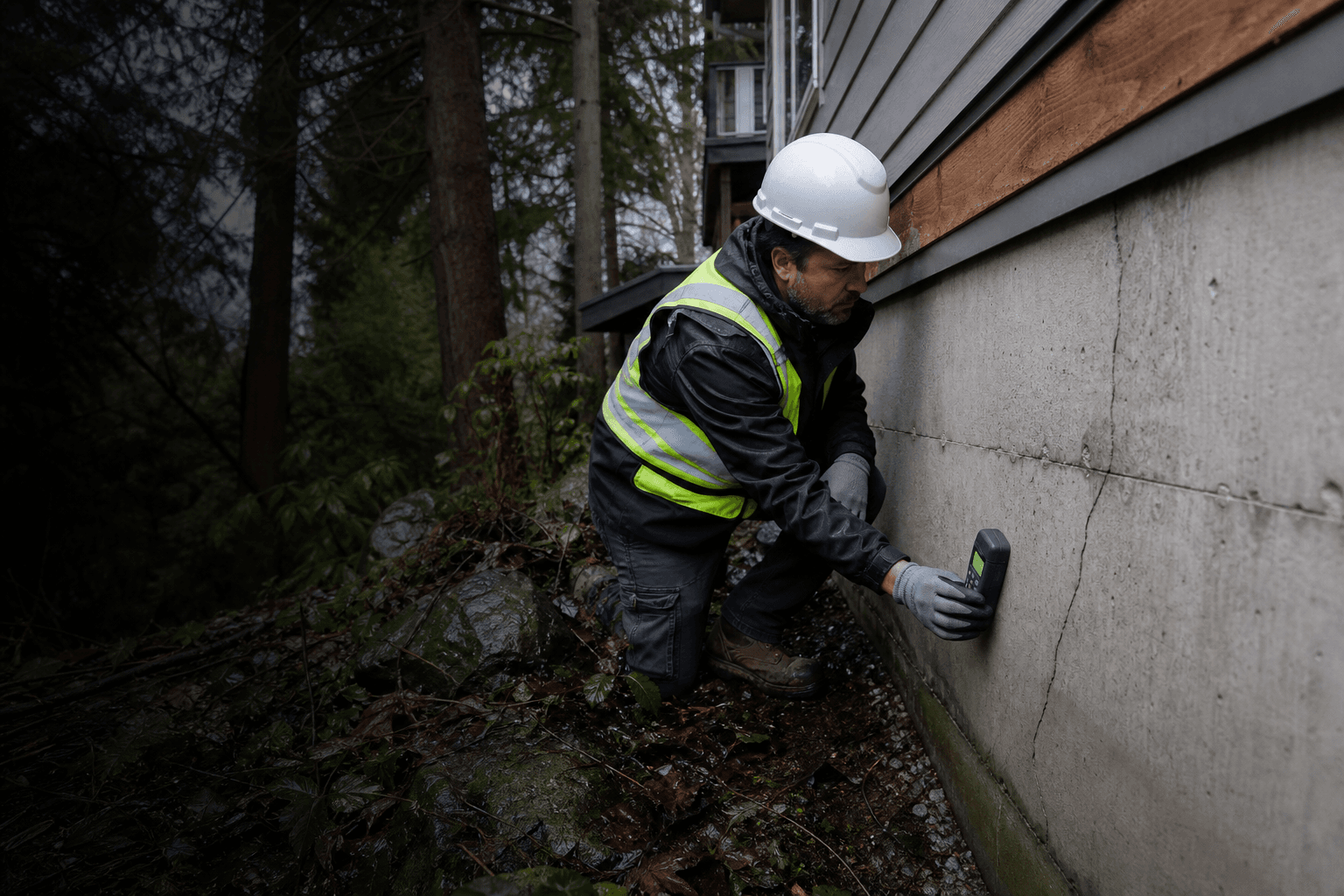
A floor that runs downhill toward one corner is one of the clearest signs a house is moving. Sometimes the slope has been there since the day the house was built, and it is just an old floor doing what old floors do. Sometimes it showed up in the last year, and that is a different story. Elite Vancouver Foundation Repair gets called for both, and the first job is telling them apart.
How a Slope Actually Forms
A wood floor is only as level as whatever holds it up. In a Vancouver house that is usually one of three things: the foundation footings, the posts and beams in a crawl space or basement, or the joists themselves.
When a footing sinks, everything above that corner sinks with it. The floor tilts toward the low side. Drywall cracks open at the corners of doors. Baseboards pull away from the floor on the high side and pinch on the low side. The whole room, and often the rooms beside it, lean the same direction.
When a crawl space post rots, or a beam sags in the middle, the dip is local. You feel it in one hallway or one room, and the rest of the house is fine. This is extremely common here. A lot of Metro Vancouver homes sit over a damp crawl space with no vapour barrier, and a wood post on a concrete pad stays wet for most of the year. The bottom few inches turn soft, the post shortens, and the beam above it drops.
When the joists are the problem, the floor bounces or dishes between the walls, and the walls themselves stay put. Undersized joists, joists notched for plumbing, and joists that have lost their connection to the rim are a floor problem, not a foundation problem. Jacking the foundation will not fix them.
A Way to Sort It Out at Home
Set a marble on the floor and let it roll. Then do it in the next room, and the one after that. If every marble runs toward the same corner of the house, you are looking at the foundation or a main beam. If the marble only runs in one room and stops at the doorway, you are probably looking at the joists or a single post.
Measure it if you can. A 4-foot level, with a tape under the low end, is enough. Write down the gap and the date. A slope of about an inch over 20 feet is enough to feel underfoot and enough to stick a door. Older houses are often out by that much and have been for decades. What matters more than the number is whether it is changing. Check again in six months. If the gap grew, the house is still moving.
Look at what the slope lines up with. A low corner under a downspout that dumps against the foundation, beside a large tree, or on the side of the house that was added later is a clue. So is a low spot in the middle of a room with a crawl space under it.
What the Ground Under Vancouver Does to Floors
The soil here is not one thing, and the slope in the floor depends on which part of the region the house sits on.
Richmond, Delta, and parts of South Vancouver sit on delta silt, sand, and pockets of peat. Houses there can settle slowly for decades as that soil compresses under the weight of the building. A gentle, even slope across a whole Richmond rancher is often that long, slow compression, and it is not always urgent. The useful questions are whether it is still moving, and whether one side is dropping faster than the other.
Burnaby, East Vancouver, and parts of Coquitlam sit on clay that swells when it is soaked and shrinks when it dries. A dry summer followed by a wet winter can tilt a floor that was fine the year before. The movement is usually worse on the side of the house where the soil stays wettest.
North Shore and other hillside homes are different again. The slope you feel inside can be the house creeping down the hill, not just sinking straight down. Look outside for a porch pulling away from the wall, a gap opening at the garage, or cracks in a retaining wall below the house. Piers that only resist vertical load do not stop a house that is sliding.
Fill is its own category. Where a lot was filled and not compacted well, including some newer infill lots, the house settles where the fill is deepest. The original part stays put and the addition drops. You can often see the line where the two meet, in the floor and in the drywall above it.
When It Can Wait, and When It Cannot
A floor that has been out of level since you bought the house, with no new cracks and no doors getting worse, can usually wait for a planned repair. Have it looked at so you know the cause, then decide on timing.
Call sooner if any of these showed up recently:
- The slope is new, or a slope you already knew about got worse this year.
- Doors that used to latch now need a shove, and it is happening in more than one room.
- New cracks run out of the corners of doors or windows, or a stair-step crack opened in the brick or block outside.
- A gap is opening between an addition and the original house, or a chimney is pulling away.
- A crawl space post is soft, crushed, or standing in water.
Those are signs the support under the floor is still giving way. Waiting turns a post replacement into a joist replacement, and a smaller pier job into a bigger one.
How the Repair Gets Chosen
The fix follows the cause. There is no single product for a sloping floor.
If a crawl space post has rotted, the beam is shored so the house does not move, the post comes out, and a new concrete footing with an adjustable steel column goes in its place. A sagged beam is sistered or replaced at the same time if the wood is gone. This is often the whole repair, and the floor can be brought back close to level while the new post is set.
If the joists are the problem, they get sistered, or a new beam is added under them. The foundation is left alone.
If a footing has settled and it is still moving, that footing is underpinned. On most houses here that means steel piers, helical or push piers, taken down to soil that can actually carry the house. Once a pier is seated, its bracket can lift that corner back toward level. How far it is safe to lift depends on the house. Plaster, tile, and old plumbing all have a limit, and a careful lift stops before something else breaks. Stopping the movement matters more than chasing a perfect bubble on the level.
A settled concrete slab in a garage or a basement is a separate job. Those slabs are usually not holding the house up. Foam injected under the slab can fill the void and raise it without digging it out. That does nothing for a footing that is still sinking beside it.
What Not to Do First
Do not start with new flooring. Hardwood laid over a slope you have not diagnosed will crown, gap, or slope the same way, and you will have paid for it twice.
Do not shim the bottoms of walls and call the floor levelled if you have not found out why it dropped. Shims hide the symptom and leave the post, the footing, or the soil doing whatever it was already doing.
And do not assume the worst from one room. A bouncy floor in a 1950s bungalow is very often just the joists. A lean across the whole house toward one corner is very often the ground. They are priced differently and repaired differently, and a proper assessment tells you which one you have before anyone mentions piers.
If your floors slope, or they have started to, Elite Vancouver Foundation Repair will come out, measure the fall, check the crawl space or basement, and tell you whether the house is moving and what it would take to stop it. The assessment is free, and you get a straight answer either way.
Elite Vancouver Foundation Repair Team
Foundation repair specialists serving Greater Vancouver